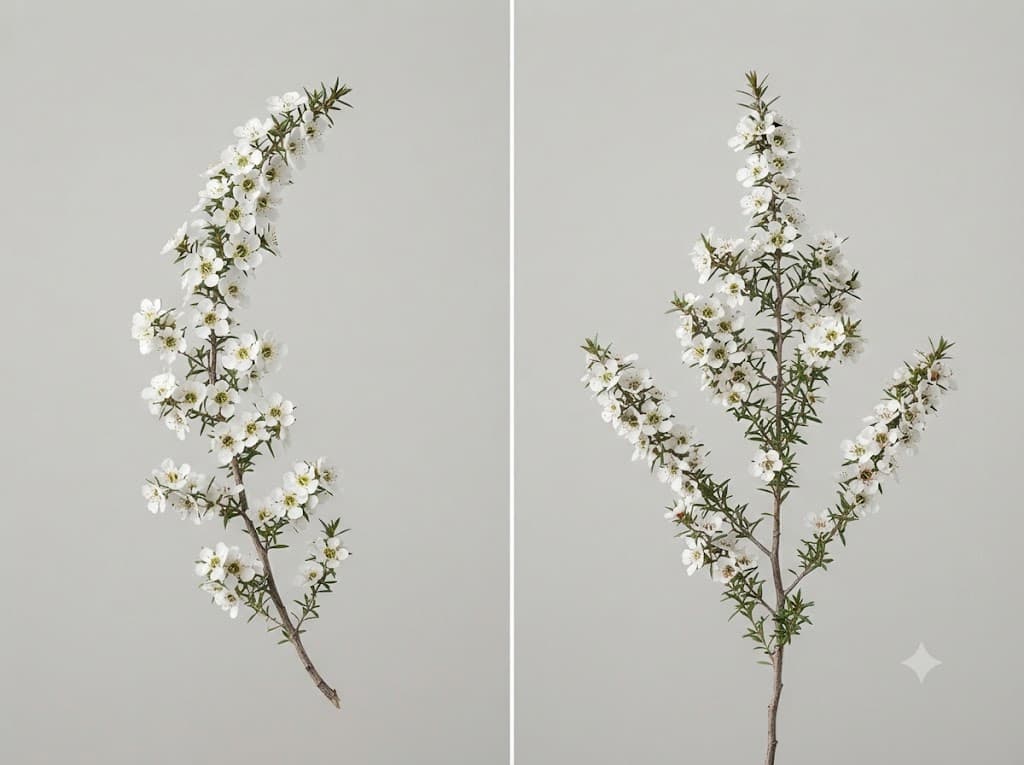
The manuka tree grows in both countries and both may use the name. The real difference is the five-attribute test New Zealand applies to honey labelled manuka for export.
Shop for Manuka honey in Australia and you will find jars from both sides of the Tasman, often on the same shelf, often at very different prices. So is Australian Manuka honey the same thing as New Zealand Manuka honey? There is a precise answer, and it is not about quality. It is about what the word on the label has to prove.
Start with the botany, because it settles one argument straight away. Leptospermum scoparium, the Manuka tree, is native to both New Zealand and south-eastern Australia. In Australia it is more often called tea tree, and there are plenty of other Leptospermum species there too.
So honey from Manuka-type flowers really is produced in both countries. Anyone telling you Australian Manuka honey is not real honey from a real Manuka flower is overstating it.
This is what actually separates the two, and it is worth knowing before you compare prices.
Since December 2017, New Zealand’s Ministry for Primary Industries has applied a scientific definition to any honey labelled as Manuka for export. It is not a marketing standard or a brand programme. It is a government test, and honey has to pass all five attributes to carry the name.
| New Zealand | Australia | |
|---|---|---|
| Does the Manuka tree grow there? | Yes, native | Yes, native. Usually called tea tree |
| May producers use the name “Manuka”? | Yes | Yes |
| Government definition attached to the word | Yes. MPI’s five attributes, since December 2017 | No equivalent scheme |
| What that definition tests | Four chemical markers plus Manuka pollen DNA | n/a |
| Applies to | Honey labelled Manuka for export | n/a |
| Label categories it sorts into | Monofloral or multifloral | Set by each producer |
| Grading marker used on labels | MGO, in mg/kg | MGO, in mg/kg |
Monofloral means the bees foraged mainly on Manuka. Multifloral means a greater share of other flowering plants went in. The thresholds are what separate the two, and both categories have to clear every attribute.
Australia has no equivalent government definition tied to the word. Australian producers test and grade their honey, and many do it thoroughly. But “Manuka” on an Australian jar is not certifying passage through that particular five-attribute scheme, because that scheme is a New Zealand export requirement.

This was fought over for the best part of a decade. New Zealand producers applied to restrict the term to New Zealand honey, and the attempt failed. It failed in the United Kingdom, in the European Union, and finally at home, where in 2023 New Zealand’s own Intellectual Property Office found the word was descriptive rather than tied to one country. The New Zealand applicants withdrew, leaving those rulings standing.
What that means for a shopper in Melbourne or Auckland: “Manuka honey” on an Australian product is a lawful description, not a loophole. You are not being misled. You are looking at a word that carries a specific testing obligation in one country and not in the other.
Ignore nationality as a shortcut for quality. Read for the same three things either way.
MGO in mg/kg is a lab measurement of methylglyoxal concentration, a chemical marker used to grade Manuka honey. A number with no unit, or a vague “strength” word, is not a measurement.
Graded honey has a certificate of analysis. It is a lab record of what was measured in that lot. The honey we sell is graded MGO 263+ on the supplier’s certificate of analysis, and we will send you a copy if you ask. Any seller on either side of the Tasman should be able to do the same.
Country of origin is required information on both sides of the Tasman, and on a busy front label it is easy to skim past. If a jar is coy about it, that tells you something in itself.
One practical note, because it catches people out. Australia applies biosecurity conditions to honey arriving from overseas. The rules for a jar in your suitcase are not the same as for a commercially imported, packaged and labelled product. Western Australia has historically been stricter again on honey coming in.
If you are travelling with a jar rather than buying one locally, check the current conditions with the Department of Agriculture, Fisheries and Forestry before you fly, and declare it when you arrive. Buying from a seller who already ships into Australia avoids the question.
No. The Manuka tree is native to both countries, and the name is a lawful description in Australia. What differs is that New Zealand applies a five-attribute government definition to honey labelled Manuka for export, and Australia has no equivalent scheme attached to the word.
The definition was set for honey labelled as Manuka for export. MPI has said honey sold domestically must meet all existing regulatory requirements, and that extending the Manuka definition to the domestic market needs further policy work. So a jar bought in a New Zealand supermarket is not automatically covered by the same test as one shipped overseas.
MGO is a concentration of one compound, measured in mg/kg. It climbs steeply in price and it does not describe taste, texture or colour. For everyday eating a mid-range grade covers it. We sell one, MGO 263+, in 250g and 500g jars and multi-jar packs.
Honey is subject to biosecurity conditions on arrival, and the rules differ between personal luggage and commercially packaged imports. Western Australia has historically been stricter. Check the current conditions with the Department of Agriculture, Fisheries and Forestry before travelling, and declare it.
The Manuka tree grows in both countries, and Australian producers are legally entitled to the name. The real difference is that New Zealand has a five-attribute government definition, four chemical markers plus Manuka pollen DNA, that honey must pass to be labelled Manuka for export. Australia does not have an equivalent.
That is a difference in testing regime, not a verdict on either country’s honey. Once you know it exists you can stop shopping by flag and start shopping by document. A grading figure with a unit, and a certificate you can ask to see.
The honey we sell is graded MGO 263+ on the supplier’s certificate of analysis. That is the lab record behind the number on the jar, and we will email you a copy. No purchase needed, and no form beyond your email address.
Questions about grading, sizes or delivery to New Zealand and Australia go to the same place: info@puresummit.co.nz.
This article is part of our full guide: Manuka honey grading explained, and how to read any label.