
Does MGO increase over time in a jar of manuka honey?
MGO is not a fixed figure. It forms from DHA while the honey sits, and over long periods in warm conditions it can fall again. Here is what has actually been measured, and what it means for a jar in a cupboard.
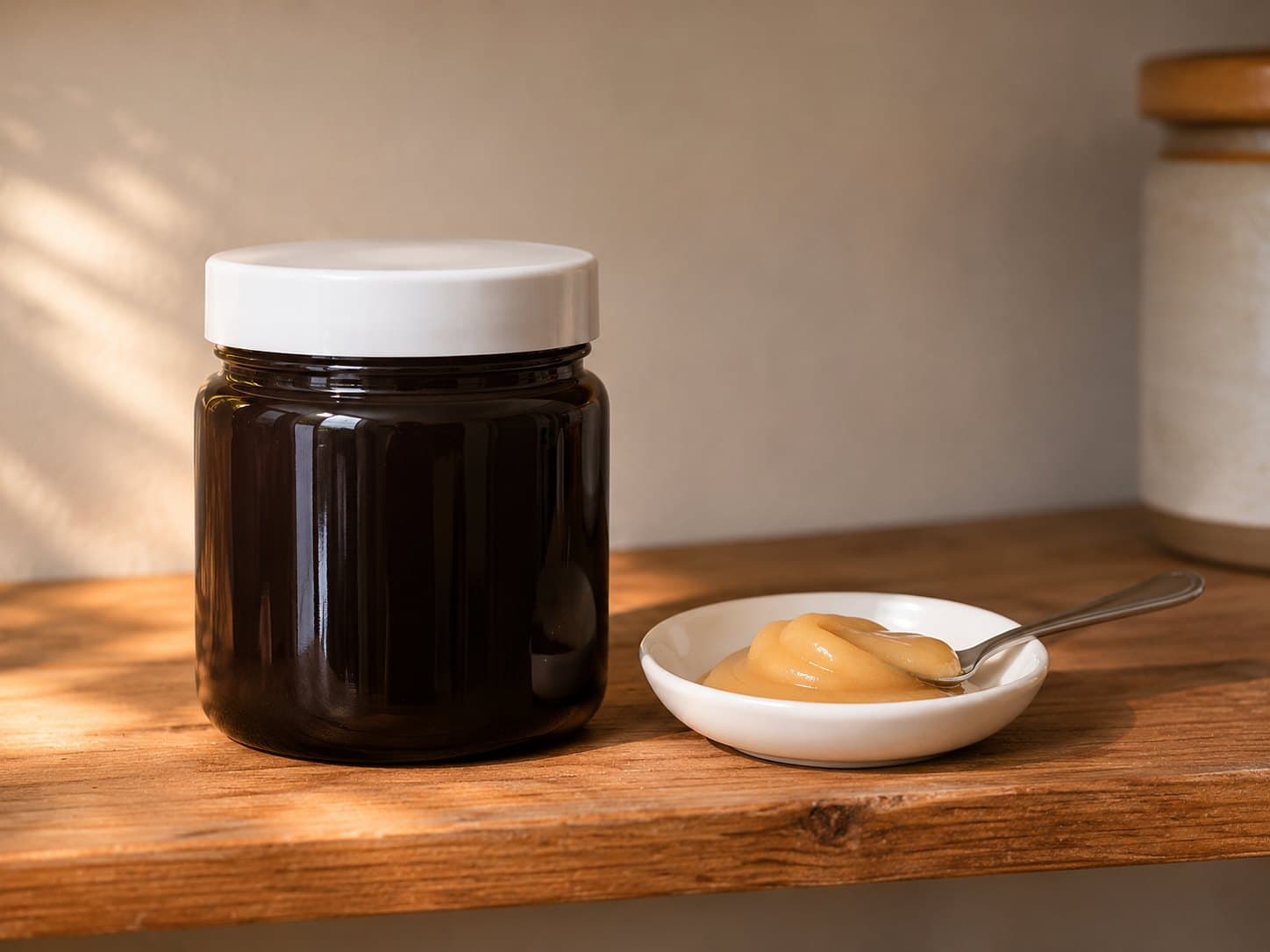
A jar of manuka honey sits in a cupboard for a year. The label still says the same number it said on the day it was packed. Does MGO increase over time, or is the figure fixed?
It is a fair question and most of the answers online are guesses. The honest version is that the number does move, it does not only move upward, and what has actually been measured is narrower than what gets claimed.
The short answer
Methylglyoxal levels in manuka honey are not fixed. They rise as the honey sits, because the compound is still being formed. Given enough time and warmth, they can also fall again.
So a grade is a reading taken on a date, not a permanent property of the honey.
Where the movement comes from
The methylglyoxal in manuka honey is not there at the start. It forms from dihydroxyacetone, or DHA, which comes from the nectar of the manuka flower. Fresh honey is high in DHA and low in MGO, and the one turns into the other while the jar sits.
We explain the three terms in MGO vs methylglyoxal vs DHA. The short point for this post is that the honey arrives holding a stock of DHA, and the MGO figure is a snapshot of how much of it has converted so far.
Does MGO increase over time, or settle?
Both, depending on how long and how warm.
Chemists at the University of Waikato ran the kinetics on this. They stored manuka honeys, and clover honeys dosed with DHA, at temperatures from 4 °C to 37 °C and tracked both compounds. Three findings are worth knowing.
- Warmer is faster. Raising the storage temperature sped up the loss of DHA and the early formation of MGO.
- Cooler converts better. Despite being slower, lower temperatures gave better conversion efficiency. More of the DHA ended up as methylglyoxal.
- It can go back down. At 37 °C, more MGO was lost at the later time points in manuka honey than in the dosed clover honey. The curve is not a one-way climb.
That study is Kinetics of conversion of dihydroxyacetone to methylglyoxal in New Zealand manuka honey, published in Food Chemistry in 2016 by Grainger, Manley-Harris, Lane and Field.
What that means for a jar in a kitchen
Less than the numbers above might suggest, and this is the part that usually gets skipped.
37 °C is an accelerated ageing condition. It is a way of making months of change happen in weeks so it can be measured. It is not a cupboard in Auckland. Reading a laboratory result at 37 °C as a prediction for your pantry is the most common mistake in the articles on this topic.
Two things follow from that.
There is nothing to do. A normal cupboard, out of direct sun, is the whole of the storage advice. Warming honey on purpose to push the number up trades conversion efficiency away and risks losing methylglyoxal at the far end, so it is not even a good trade on its own terms.
You cannot work out your own jar’s current figure. The rate depends on the starting DHA, the temperature history and properties that vary between honeys. There is no sum you can do at home, and any seller who gives you one is making it up.
Why the label has a plus sign
This is exactly what the “+” is for. A grade written as MGO 263+ is a floor, not an average and not a precise reading of the jar in your hand. It says the honey met at least that figure when it was tested.
A moving number is the reason the convention exists. What MGO 263+ actually means on a label covers the plus sign and how to read the rest of the label properly.
What this does not mean
Two conclusions people reach from this that the research does not support.
It does not mean an older jar is a better one. The MGO figure is a measurement of the concentration of one compound. It is not a quality score, and a larger number is not a sign of a better honey. Manuka honey is sold as food in New Zealand and Australia, and under the Food Standards Code food cannot carry therapeutic claims, so read the figure as a measurement and nothing more.
It does not mean the grade on a jar is unreliable. A dated certificate against a minimum figure is a reasonable way to describe something that changes slowly. What would be unreliable is a number with no test and no date behind it.
Where our own number comes from
We buy finished, graded honey and sell it. We keep no hives and we run no tests. The MGO 263+ on our label is the figure on the supplier’s certificate of analysis, and we will email you that certificate if you want to read it, with nothing to buy first.
The honey is creamed, so it is set and spreadable rather than runny. That is a processing choice and has nothing to do with the grade. The 500g jar is here.
The short version
MGO is not fixed. It forms from DHA in the honey over time, so it rises, and in warm conditions over long periods it can fall again. Warmer storage is faster but converts less efficiently. Laboratory results at 37 °C are accelerated tests and do not describe a kitchen cupboard. Keep the jar somewhere normal, read the grade as a dated minimum, and ignore anyone who offers to calculate your jar’s current figure.
More from the Journal
MGO vs methylglyoxal vs DHA: which word means what
17 November 2026Post by Alex

How is MGO measured? What a laboratory actually does to a jar of manuka
13 November 2026Post by Alex

Is MGO 263+ a high grade? Where it sits on the manuka scale
10 November 2026Post by Alex
Manuka Honey Grading Explained: What Is Measured and How to Read Any Label
29 September 2026Post by Alex