
Is MGO 263+ a high grade? Where it sits on the manuka scale
MGO 263+ sits in the lower middle of the manuka range. Here is how the grades actually run on the shelf, and what a mid-range number means for the jar you take home.
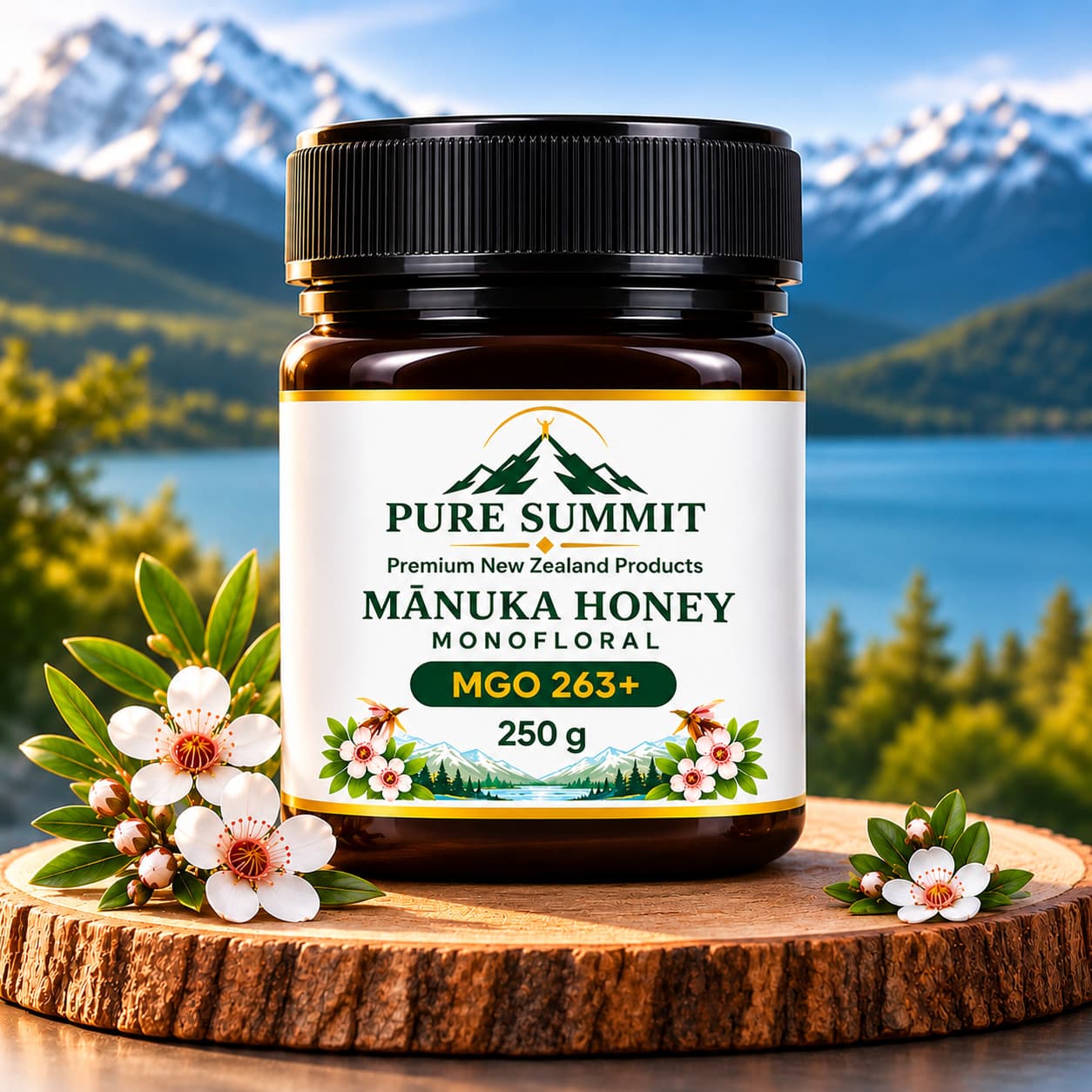
If you have been comparing jars, you have seen the numbers jump around. One shelf has MGO 100+. The next has 263+, then 400+, then something with four digits and a price to match. It is reasonable to look at 263 and wonder whether that is a lot or a little.
Here is the honest placement, and then what it actually means for the jar you take home.
The short answer
MGO 263+ sits in the lower middle of the range sold in New Zealand. It is clearly above the entry-level grades. It is well below the top of the market.
That is a description of where the number falls, not a verdict. The scale is a concentration, so a higher number means more of one compound in the jar and nothing else. We go into what the figure records in what MGO 263+ actually means on a label. This post is about the shape of the range itself, because that is the part nobody lays out.
What the numbers on the shelf run to
Graded manuka honey is usually sold in tiers. You will commonly see figures in this order:
- Around 30 to 100. The entry grades. Often labelled multifloral.
- Around 250 to 300. Where MGO 263+ sits. The first tier where monofloral labelling is common.
- Around 400 to 550. A step up in price, usually a step up in flavour intensity too.
- Around 800 to 850. Premium shelf.
- 1000 and above. The top of the market, priced accordingly.
The exact tier boundaries differ between sellers, because there is no rule forcing anyone to stop at round numbers. What stays constant is the unit. Every one of those figures is milligrams of methylglyoxal per kilogram of honey, measured in a laboratory and recorded on a certificate.
So 263 is not a score out of a thousand. It is a measured quantity that happens to be expressed as a number, which is exactly why it looks like a ranking when it is not.
Why the scale is not a quality ladder
A jar at 800 has roughly three times the methylglyoxal of a jar at 263. That is the whole of the difference the number describes.
It does not describe how well the honey was handled. It does not describe texture, which comes down to processing rather than grade. It does not tell you whether the honey meets the Ministry for Primary Industries definition of manuka, because that is a separate test with its own markers. A jar can carry a large MGO figure and still be a weaker buy than a smaller figure from a seller who can produce the paperwork.
Price does not scale evenly either. Moving up the tiers costs considerably more per hundred grams, and the jump is steepest at the top. You are paying for scarcity, because high-MGO honey is a smaller share of each season’s crop.
What 263 means for the jar in your hand
Three practical things follow from a mid-range grade.
Flavour. Manuka at the higher grades is generally reported as stronger and more bitter. A mid-range grade keeps more of the honey character, which is why it is the tier most people find easy to eat daily rather than occasionally.
Quantity. Because the price per hundred grams is lower than the premium tiers, a mid grade is the range where a 500g jar is a realistic household purchase rather than a treat.
Labelling. At this tier you will usually see the word monofloral or multifloral on the jar. Honey labelled as manuka for export from New Zealand has to be tested against the Ministry for Primary Industries definition by a laboratory MPI recognises. That test places each batch in one of those two classes. Ours is labelled monofloral, which comes from the supplier’s certificate of analysis rather than anything we determined.
How to choose a grade
We stock one grade, so take this as the reasoning rather than a recommendation to buy from us.
Work backwards from how you will use it. Honey you will spread on toast a few times a week is a different purchase from a jar you will open twice a year. A mid grade makes sense for the first. If you specifically want the strongest flavour available and are not worried about the price per gram, the upper tiers exist for that.
Then check the paperwork before the number. A seller who can send you a certificate of analysis for the honey in the jar is telling you something more useful than a bigger figure printed on a label. The figure is a claim until a document stands behind it. Our full guide to manuka grading walks through what to look for on any jar, from any brand.
Where our own number comes from
We buy finished, graded honey and sell it. We keep no hives and run no tests. The MGO 263+ on our label is the figure on the supplier’s certificate of analysis for that honey, printed exactly as it appears there.
We will email you that certificate if you want to read it. There is nothing to buy first. You can request a copy from the lab reports page.
The short version
MGO 263+ is a mid-range grade: above the entry tiers, below the premium ones. The number is a measured concentration of one compound, so a bigger figure means more of that compound and a higher price, not a better jar. Choose the tier that suits how often you will actually eat it, and check that whoever is selling it can show you the certificate behind the number.
Our MGO 263+ comes in 250g and 500g jars, and in multi-jar packs.
More from the Journal
Does MGO increase over time in a jar of manuka honey?
17 November 2026Post by Alex
MGO vs methylglyoxal vs DHA: which word means what
17 November 2026Post by Alex
How is MGO measured? What a laboratory actually does to a jar of manuka
13 November 2026Post by Alex
Manuka Honey Grading Explained: What Is Measured and How to Read Any Label
29 September 2026Post by Alex